EAC launches regional bond, removes trade barriers for Kenya
By William Muthama, August 4, 2025The East African Community (EAC) has officially launched the EACBond, a regional customs guarantee mechanism that will revolutionise the movement of goods across Partner States.
The launch ceremony took place in Kampala, Uganda, on Monday, August 4, 2025, bringing together key stakeholders, including government representatives, customs officials, insurance firms, banks, and logistics providers.
The EACBond replaces the longstanding practice of requiring traders to purchase multiple national bonds when transporting goods across borders. With this new system, a single bond can now cover the entire journey through multiple EAC countries, streamlining the trade process and reducing financial and administrative burdens.
Trade costs slashed
According to the EAC, the EACBond will significantly reduce trade costs across the region. By eliminating multiple border bond charges, traders will no longer need to pay separately at every country crossing. This reduction in costs is expected to lower consumer prices as well, offering direct benefits to East African citizens.
“By allowing traders to secure their entire cargo journey with a single bond, the EACBond will significantly reduce trade costs, ease border delays and free up business capital,” said an official from the EAC secretariat during the launch.
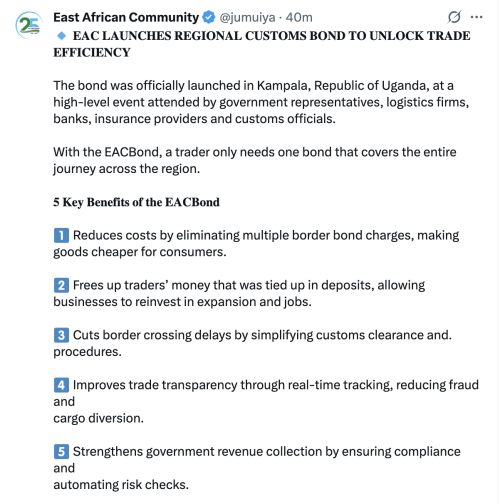
Additionally, the EACBond frees up traders’ capital that was previously tied up in deposits for each national bond. “With the EACBond, a trader only needs one bond that covers the entire journey across the region,” the official added. This means businesses can reinvest that money into expansion, job creation, and improving operations. The ability to operate with one unified bond marks a major policy shift in regional integration.
Borders move faster
The introduction of the EACBond is also expected to ease congestion at border points. With simplified customs clearance procedures and reduced paperwork, border delays will become shorter, enabling faster delivery of goods across the region.
“[It] cuts border crossing delays by simplifying customs clearance and procedures,” the EAC said in a statement. This will be especially beneficial for time-sensitive cargo and perishable goods.
Real-time tracking of bonded cargo will also enhance trade transparency and curb fraud. According to the EAC, this “improves trade transparency through real-time tracking, reducing fraud and cargo diversion.” Governments are projected to benefit from improved revenue collection, as the bond system will enforce more consistent procedures across borders.