Bankers urge Parliament to review competition and microfinance bills
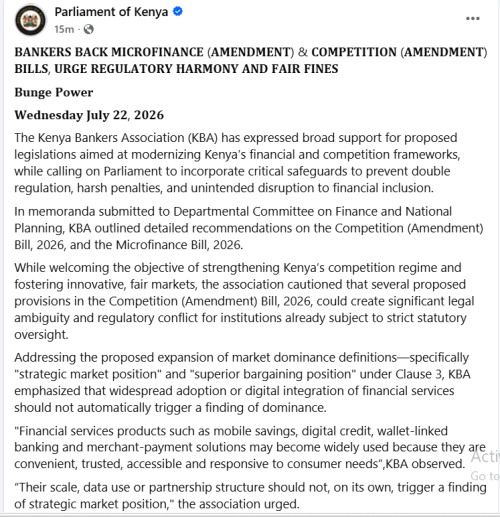
By Faith Lagat, July 22, 2026The Kenya Bankers Association (KBA) has urged Parliament to strengthen safeguards in the Competition (Amendment) Bill, 2026, and the Microfinance Bill, 2026, saying some of the proposed provisions could result in regulatory overlap, excessive penalties and affect financial inclusion.
In memoranda submitted to the National Assembly Departmental Committee on Finance and National Planning, the association welcomed efforts to modernise Kenya’s competition and microfinance laws but proposed changes to several clauses before the Bills are passed.
KBA said the amendments should support innovation, consumer protection and financial stability while avoiding unintended consequences for financial institutions and customers.
Competition Bill concerns
On the Competition (Amendment) Bill, 2026, KBA raised concerns over the proposed expansion of market dominance definitions through the introduction of “strategic market position” and “superior bargaining position” under Clause 3.
The association said the widespread use of financial products such as mobile savings, digital credit, wallet-linked banking and merchant payment solutions should not automatically result in a finding that an institution holds a strategic market position.
“Financial services products may become widely used because they are convenient, trusted, accessible and responsive to consumer needs. Their scale, data use or partnership structure should not, on its own, trigger a finding of strategic market position,” KBA said.
The association proposed that the Competition Authority of Kenya (CAK) should first demonstrate “substantial and durable market influence” before designating any institution as having a strategic market position.
KBA also called for exemptions for institutions complying with Anti-Money Laundering and Counter-Financing of Terrorism (AML/CFT) regulations, data protection laws, cybersecurity requirements and prudential guidelines.
It further opposed the proposal to impose administrative fines of up to 10 per cent of an institution’s gross annual turnover, saying the penalties could disproportionately affect large institutions regardless of the scale of the breach.
Instead, KBA recommended capping penalties at one per cent of the turnover generated from the affected service or Ksh 100 million, whichever is lower.
Microfinance proposals
On the Microfinance Bill, 2026, the association supported efforts to strengthen oversight by the Central Bank of Kenya (CBK) but objected to Clause 13(1), which proposes increasing the minimum core capital requirement for microfinance institutions from Ksh 60 million to Ksh 250 million.
KBA recommended retaining the current threshold or gradually increasing it to between Ksh 100 million and Ksh 150 million.
“The proposed increase represents a substantial jump that may not adequately reflect the current operating environment of the sector,” KBA said.
It noted that many microfinance institutions continue to face profitability challenges and rising credit losses, warning that an immediate increase could force some institutions out of the market, trigger consolidation and reduce access to financial services for micro, small and medium enterprises (MSMEs), women, youth and rural communities.
The association also opposed Clause 58(1), which would bar non-deposit-taking microfinance institutions from accepting cash collateral.
According to KBA, loan-linked cash collateral remains an important risk management tool, particularly in group lending programmes serving low-income borrowers.
Committee to consider proposals
KBA proposed that non-deposit-taking microfinance institutions should continue receiving loan-linked cash collateral provided the funds are segregated, fully disclosed, not used for intermediation and refunded once a loan has been fully repaid.
The association also called for closer coordination between the Competition Authority of Kenya, the Central Bank of Kenya, the Capital Markets Authority, the Insurance Regulatory Authority and the Sacco Societies Regulatory Authority to prevent overlapping investigations and conflicting regulatory directives.
In its submissions, KBA said it supports a legislative framework that balances consumer protection, financial stability, innovation and economic growth.
National Assembly Departmental Committee on Finance and National Planning Chairperson Kuria Kimani said the committee had taken note of the issues raised by the banking sector and would consider the recommendations as lawmakers prepare their report on the two Bills.