Africa-France Summit: Business leaders push for real investment, not aid
By Kenneth Mwenda, May 11, 2026African and French business organisations have urged leaders meeting at the Africa Forward Summit to move away from aid-style cooperation and focus on joint investment that builds industries and jobs.
In a joint statement released at the start of the two-day summit in Kenya, the groups called for a shift from “scattered financial flows” to targeted co-investment that strengthens production and creates long-term value on African soil.
Joint declaration
The joint declaration was signed by senior business leaders representing major African and French private sector organisations. They include Baidy Agne, Chairman of Business Africa; Ahmed Cissé, Chairman of the Alliance des Patronats Francophones; Carole Kariuki, CEO of the Kenya Private Sector Alliance (KEPSA); and Philippe Labonne, Chairman of the Africa Committee at MEDEF International.
The statement was presented under the Africa Forward Summit 2026 framework in Nairobi, where business leaders from both regions agreed on a shared roadmap for investment-led cooperation.
They said the partnership must now focus on one core goal: building value chains, industrial capacity and skills together.
“The business partnership and economic cooperation between France and African countries must enter a new phase, based on co-investment, the creation of sustainable jobs, skills development, support for the growth of local production sectors, and industrial transformation,” the statement reads.
The organisations warned that rising geopolitical tensions, energy transitions and rapid digital change are reshaping global economies. They said Africa and France must respond with practical cooperation, not declarations. They also stressed that young people on both continents want skills, employment and opportunities to build businesses, not dependency.
Statement outlines four main priorities
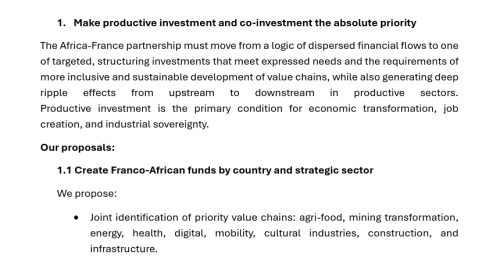
First, it calls for productive investment to drive the partnership. The groups want joint Franco-African funds targeting sectors such as agri-food, mining transformation, energy, health, digital services and transport. These funds would combine public and private capital and support African small and mid-sized firms across entire value chains.
They also propose blended finance tools, guarantees to reduce investment risk, and a single support desk for structuring bankable projects.
“Productive investment is the primary condition for economic transformation, job creation, and industrial sovereignty,” they state.
Second, they call for a more stable business environment. Governments are urged to ensure predictable tax and regulatory systems, faster digital public services and stronger investor protection.
The statement also backs full implementation of the African Continental Free Trade Area, including reduced trade barriers and harmonised customs systems. Business organisations want a stronger role in policymaking through structured dialogue with governments.
Third, the groups want measurable results. They propose an annual impact report tracking investment flows, jobs created, local production levels and skills transfer.
They also suggest a “Co-produced Africa-France” label for joint projects that meet agreed standards. In addition, they want an annual private-sector-led business forum and stronger involvement of African and French firms in European investment programmes.
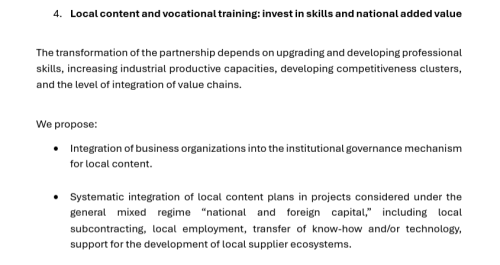
Fourth, they emphasise skills and local content. They say all major projects should include local hiring, subcontracting to African firms and technology transfer.
The statement also calls for new vocational training hubs and Franco-African sector campuses in energy, digital, agriculture and infrastructure. “The transformation of the partnership depends on upgrading and developing professional skills,” they say.
The organisations ended with a call for political action. They urged heads of state to prioritise the partnership and establish a joint public-private monitoring committee immediately after the summit to ensure commitments are delivered.
They linked their proposals to the Luanda Declaration agreed in 2024, saying the next phase must focus on implementation.
In effect, African and French companies are pressing for a more practical deal: less talk about aid, and more joint investment in industries that create jobs and lasting growth on the continent. The message from Nairobi is clear – delivery now matters more than promises.
France-Kenya ties questioned
Kenyan leaders have also raised concerns about the direction of the growing partnership with France following President William Ruto’s state visit by French President Emmanuel Macron, during which 11 cooperation agreements were signed covering infrastructure, energy, agriculture and technology.
Mukurweini MP John Kaguchia said France was not prioritising Kenya in its foreign policy, arguing that the country had instead become a fallback partner after losing influence in other regions.

“France has not chosen Kenya. Kenya is actually the only country left. They are their last option,” he said, adding that France’s presence in parts of West Africa had been weakened by resistance in countries such as Mali, Burkina Faso and Niger.
Narok Senator Ledama Olekina also urged caution, warning that Kenya should avoid being used as a “Plan B” in shifting global alliances. He said Kenya must focus on equal partnerships that deliver jobs and protect sovereignty, especially for young people.
“Kenya must demand equal-partnership terms that prioritise our sovereignty, jobs, and strategic interests, not just short-term deals,” Olekina stated.
His remarks echoed wider political concerns that Kenya should carefully assess long-term implications before deepening ties with France, despite the new agreements signed in Nairobi.