Advertisement
19 counties outperform Nairobi in employment creation – report
Tuesday 24th February, 2026 08:06 PM|

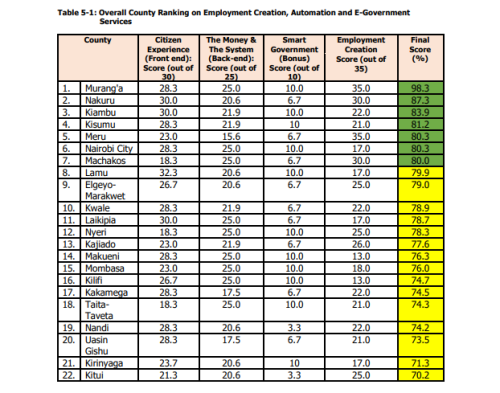
A February 2026 report from the Vision 2030 Delivery Secretariat shows Nairobi County is falling behind in creating jobs compared with many other counties. Out of 47 counties, 19 scored higher than Nairobi’s 17 out of 35 points in the employment creation category.
Despite leading in digitisation and revenue systems, Nairobi managed only 17 points out of 35. In contrast, Murang’a and Meru both scored the full 35 points, while Nakuru and Machakos earned 30 points each.
Other counties that outperformed Nairobi include Kiambu (22), Kisumu (21), Elgeyo-Marakwet (25), Kwale (22), Nyeri (25), Kajiado (26), Mombasa (18), Kakamega (22), Taita-Taveta (21), Nandi (22), Uasin Gishu (21), Kitui (25), Trans-Nzoia (19), Homa Bay (21), and Migori (18).
The report assessed employment creation using five measures: youth community work engagement (max 5 points), skills enhancement (max 9), economic empowerment (max 5), business start-up support (max 8), and policy-led implementation (max 8). Counties that scored highly ran structured, county-led programmes rather than relying on national or donor efforts.
You Might Also Like



Murang’a topped the employment chart with full marks, running the Murang’a Youth Service, which engages young people in community work, provides skill training, and organises graduation ceremonies to prepare them for jobs or business. The report includes a photo of young graduates in uniform at one such ceremony.
Meru also scored 35 points through strong legislative support, coordinated youth programmes, and backing for micro, small, and medium enterprises (MSMEs). Machakos scored 30 points with youth service graduations and skill enhancement sessions, while Nakuru also earned 30 points.
Counties like Kajiado (26), Nyeri (25), Elgeyo-Marakwet (25), and Kitui (25) built solid frameworks for youth engagement and start-up support.
Automation gains, jobs lag
Nairobi, despite its innovation hubs and overall score of 80.3 per cent (tied for sixth), performed weakly in job creation. The report notes its i-Hubs as a positive example of innovation but highlights weak structured job creation efforts.
“Counties such as Murang’a and Meru achieved maximum scores, reflecting strong legislative support, well-coordinated youth engagement programmes, and structured MSME support initiatives,” the report states.
It adds:
“Performance in this category exhibits one of the widest spreads among all four categories, with a 31-point gap between the highest and lowest scoring counties… suggesting limited institutionalisation of employment frameworks or an over-reliance on national or donor-led initiatives.”
The report warns that weak job creation holds back many counties despite strong performance in automation.
How the findings were arrived at
The Kenya Vision 2030, launched in 2008, is the national long-term development blueprint whose aim is to create a globally competitive and prosperous nation with a high quality of life by 2030. It is designed to transform Kenya into a newly industrialising, upper-middle-income nation that provides a high quality of life to all its citizens by 2030 in a clean and secure environment.
The Vision is anchored on three (3) pillars, namely: (i) Economic, which aims to sustain 10 per cent Gross Domestic Product growth; (ii) Social, which seeks to build a just, cohesive and equitable society, and (iii) Political, targeting a democratic, accountable, issue-based, people-centred and results-orientated political system.
The study utilised an exploratory research technique that relied on a desk review of secondary data available on the county governments’ websites, Office of the Controller of Budget reports, county statistical abstracts and reviews of reports in the Council of Governors Maarifa Centre. The data collected was triangulated to provide information required to fulfil the study objectives.
Author
Kenneth Mwenda
Kenneth Mwenda is a business, sports, and politics digital writer with over seven years of experience in journalism, covering breaking news, feature stories, and in-depth analysis across a range of beats.
For inquiries, he can be reached at [email protected]
View all posts by Kenneth MwendaLatest News








Advertisement
More on Business